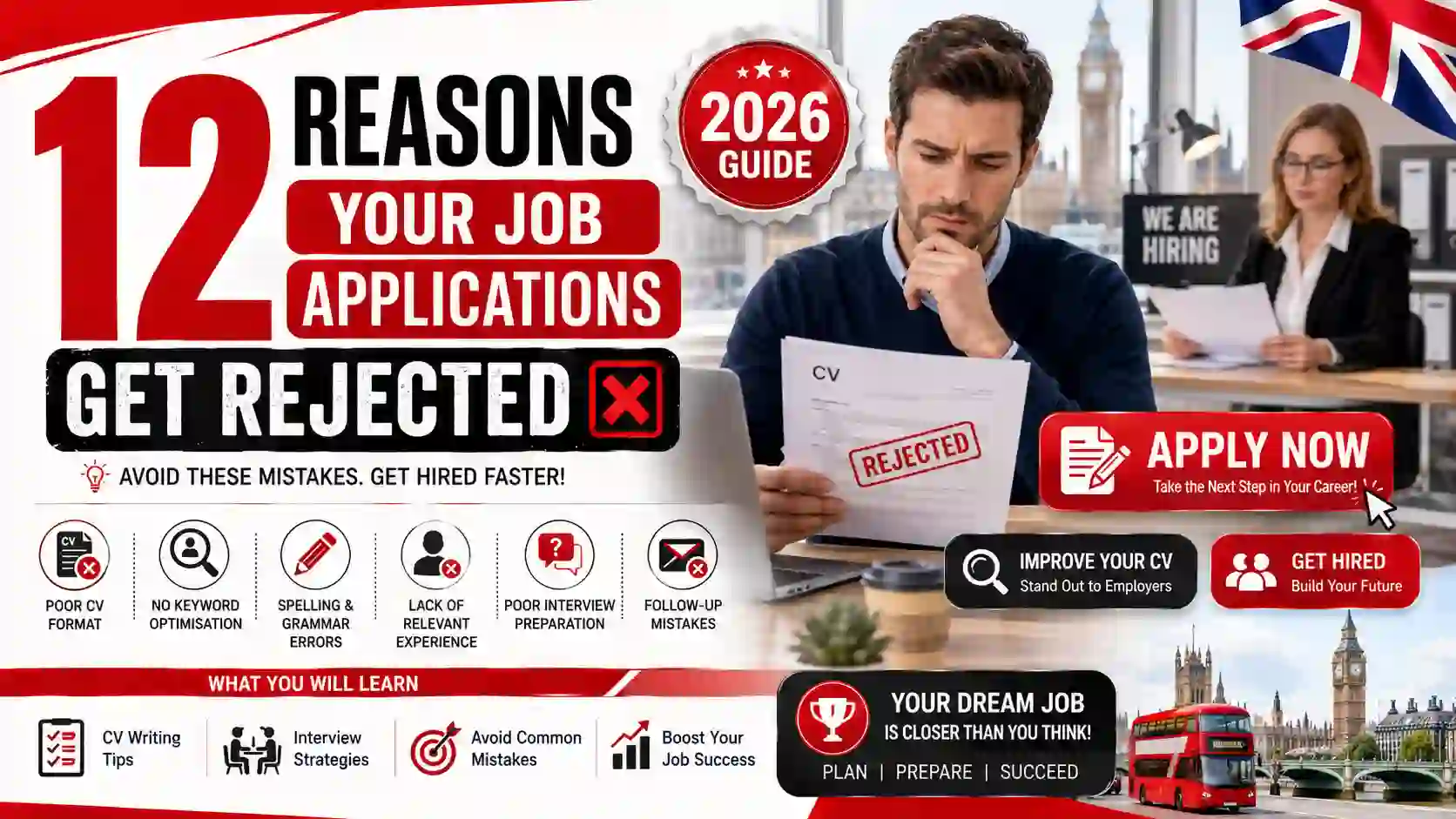
Why job applications get rejected 2026? Discover the ultimate guide to 12 common CV, interview and application mistakes that can lead to job rejection.
Why Job Applications Get Rejected 2026 – Ultimate Guide to 12 Common Mistakes
👉 Join a WhatsApp channel that posts ONLY UK visa sponsorship jobs: WhatsApp Channel
12 Reasons Your Job Applications Get Rejected
If you are often rejected, then you could be making the same blunders on your CV and throughout your interviews. If you know the most prevalent reasons for rejection, perhaps you may figure out what you can do to boost your chances of success. Here are 12 potential reasons your application can be rejected before or after the interview:
1. Not enough talents are highlighted on your CV
If you get rejected for jobs before the interview stage a lot, your CV can be poor quality. A good CV is straightforward, professional and free from spelling errors and other faults. It also shows your talents and experience well, and proves that you satisfy all the criteria that are specified in the job description. When applying for future opportunities, please ensure your CV is current with your most relevant skills and experience and that you meet the minimal job requirements.
There are several ways to mess up the initial impression when you are going to a job interview. You can arrive late or fail to say hello to your interviewer when you go into the room. If you don’t speak respectfully to your interviewer, or you seem too grungy for your interview, you can produce a negative first impression. First impressions matter a great deal, even if you excel through the rest of the interview. You should be interview-ready the moment you set foot in the interview place.
If you don’t follow directions properly in the application process, hiring managers may think you don’t follow instructions properly as an employee. Make sure you read job advertising attentively and follow instructions. If the advertisement calls for a cover letter with your application, compose one to go with your CV. If an employer is calling you for an interview they may also send you specific instructions how to prepare a presentation or something else for your interview.
Related: How to request feedback after an interview
4. Experience doesn’t cut it
If you are getting rejected from similar positions a lot, maybe you just don’t have the abilities or the experience. Check your CV against the roles you are looking for and make sure you fit all the key criteria before you apply for a job. This might be years of experience or a list of abilities and competences that you have proven through your work or school.
5. You’re Not Confident Enough
If you go into your interview feeling unconfident, this can be evident to hiring managers in the way you speak and act. A little nervousness is normal before a job interview, but when you show that you believe in your talents, hiring managers will believe in your abilities. Be confident about your past work and use clear, definitive language when talking about your skills and accomplishments. Interviewers want to see confidence, especially if you are applying for leadership roles or positions involving a lot of client engagement.
You can not only be not confident enough in your interviews, but you can also be over confident. If you come across as arrogant or cocky in your interview, hiring employers may think you’re blowing your own horn and also doubt how well you would be able to work with other colleagues as a team player. Successful applicants are confident, but not arrogant, and they know their talents and weaknesses. Be conscious of yourself when creating your CV and cover letter and in interviews.
7. You didn’t study the employer
What do you like about working for this organization? is one of the most commonly asked interview questions by hiring managers. When they ask this question they want to understand why you believe you would be a good fit for the role and organization. A excellent answer to this question demonstrates you’ve investigated the organization and know what they do and how they run. If you don’t demonstrate this in your answer, employers may think that you don’t understand the function and will not be committed to the job.
8. Too many applications for the position
Sometimes hiring managers reject promising applications because there are too many applicants for a post. In some industries, there may be hundreds of applications for one post, and in these situations, employers may reject good candidates simply to make the interview process manageable. A short, effective CV could decrease the likelihood of people passing over it for hot jobs.
9. Failure to provide instances to back up your assertions
When you go for a job interview, your interviewer might question you why you are a suitable fit for the post, or when you have used relevant abilities and competences in past jobs. Good answers to these questions will draw examples from your past work and educational experiences that demonstrate your ability to perform the requirements of the position for which you have applied. Prepare examples before your interview and use the STAR approach to give short responses.
10. You dress too informally
You might not get the job because you wore the wrong clothes for the job interview. Before attending an interview, investigate the organization and find out what kind of dress code they have. If in doubt, ask the hiring manager what the dress code is or play it safe and dress properly for your interview regardless. Looking well says you are serious about the job, that you are professional.
11. You lied about your last employment
If you’re not truthful about your employment experience on your application, this could come out when hiring managers reach out to your references or they may have a sneaky suspicion during the interview. Usually, if your employer sacked you from your former job or you left under difficult circumstances, it’s best to be truthful about this when looking for new positions and to explain why the job did not work out. If yes, show why this position is a better fit for you. If an employer finds out you lied on your application, they’re not going to hire you.
12. Another person was a better match for the job
Even if you are a really strong candidate for a position, there is still the possibility that you received a rejection because there was a stronger candidate. Sometimes overqualified applicants apply for entry level positions in various businesses, particularly competitive ones. Being defeated to a spot by a superior candidate doesn’t make you not worthy. Use every and all positive comments that comes your way to better your chances for the future.
why job applications get rejected, reasons job applications get rejected, job application rejection reasons, why CV gets rejected, CV mistakes, job interview rejection reasons, common job application mistakes, job interview tips, how to improve job applications, CV tips for job seekers, reasons for job rejection, job application tips, interview mistakes, how to get a job, UK job application tips