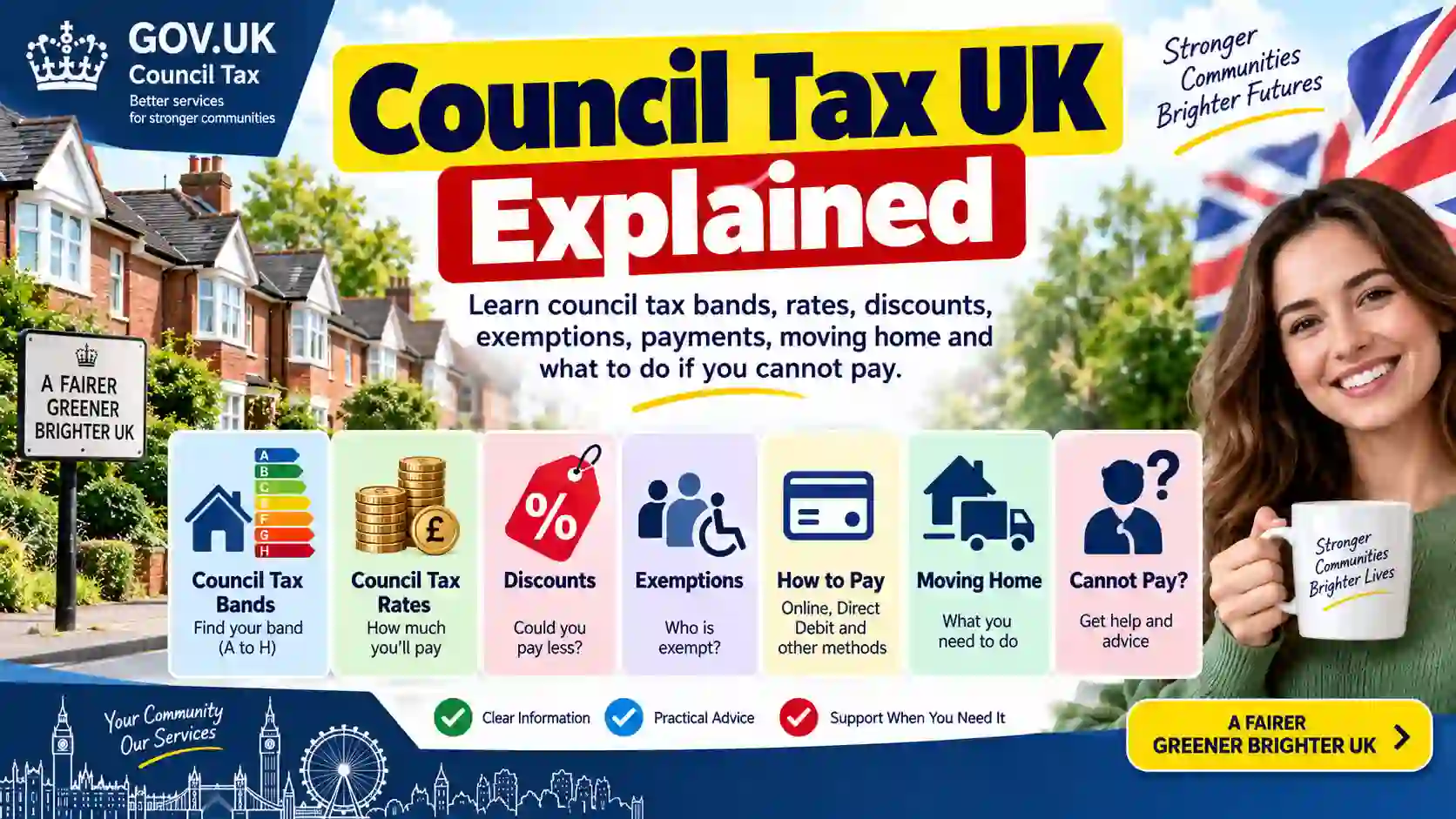
You’ve probably already seen Council Tax listed alongside rent, energy and other household costs, but the amount you pay can depend on more than your address. In this guide, we’ll explain how Council Tax works, who pays it, how bands affect bills, which discounts and exemptions may apply, and what to do when your circumstances change.
Key Takeaways
Council Tax is a local tax charged on most domestic properties to help fund local public services.
Council Tax bills vary according to factors including the property’s valuation band, local authority and applicable discounts or exemptions.
Council Tax liability depends on the property and household circumstances, including who lives there and whether anyone is disregarded.
Council Tax discounts and exemptions can reduce or remove the amount payable when specific eligibility conditions are met.
Full-time students may be disregarded for Council Tax purposes, while some student households may qualify for an exemption.
Council Tax payments should be managed promptly, and anyone struggling to pay should contact the relevant council rather than ignoring arrears.
Moving home can change your Council Tax liability and the council responsible for your bill, so you should notify the relevant councils when you move.
What Is Council Tax and What Does It Pay For?
Council Tax is a local tax charged by local authorities on most domestic properties to help pay for local public services. Council Tax helps councils raise locally collected income for services provided in their areas, while the exact services and funding arrangements vary between local authorities.
Moreover, Council Tax is not one identical national bill because each local authority sets its own charges within the applicable system. For example, two similar homes in different council areas can have different Council Tax bills even when they have the same valuation band.
At the same time, Council Tax is different from income tax because it is linked primarily to a property’s Council Tax valuation band and local authority charge. For example, your salary does not normally determine the basic Council Tax charge for your property, although your income and circumstances can affect eligibility for Council Tax Reduction.
Council Tax is administered locally, so your relevant council is the main organisation responsible for your bill, collection and many applications for reductions. The Scottish Government similarly explains that individual Scottish councils set rates, collect Council Tax and apply discounts.
For people moving to the UK, Council Tax is an important household expense to include when planning your budget. If you’re also researching employment and relocation costs, our [UK cost of living guide] can help you consider Council Tax alongside rent, utilities and other expenses.
Why Does Council Tax Matter?
Council Tax matters because it is a recurring household cost that can affect your monthly budget, payment obligations and eligibility for financial support. Understanding your bill can help you avoid missed payments and identify discounts or exemptions that may apply.
First, your Council Tax band helps determine the basic charge for your property, while your local authority determines the applicable local charge. For example, a Band D property in one council area can have a different annual bill from a Band D property elsewhere.
Second, household circumstances can change what you owe. Living alone, studying full-time, having certain people living with you or qualifying for a reduction can affect the amount payable.
Third, Council Tax is significant when planning your UK household finances. For people who have recently moved for work, guides such as [UK visa sponsorship jobs] and [UK salary guide] can be considered alongside your household-cost planning.
In 2026–27, the average Band D Council Tax set by local authorities in England is £2,392, including adult social care and parish precepts — Source: Ministry of Housing, Communities & Local Government, 2026.
That figure is an England-wide average rather than a universal bill. Your actual Council Tax depends on your local authority, property band and applicable reductions.
How Is Council Tax Calculated?
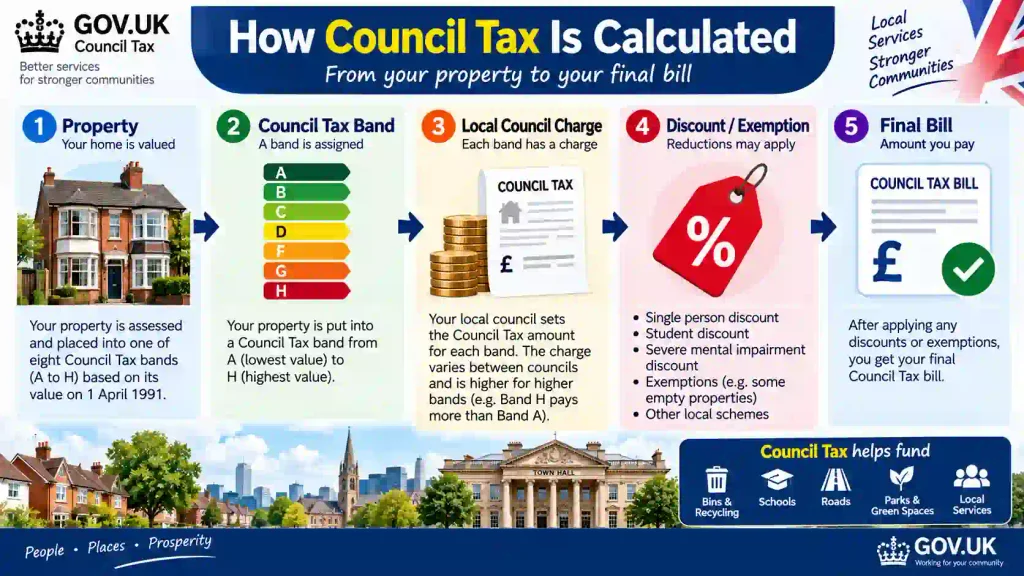
Council Tax is calculated using your property’s valuation band, the charge set by your local authority and any discounts, exemptions or reductions that apply. GOV.UK identifies these as the three main things you need to understand when working out your Council Tax.
What Are Council Tax Bands and How Do They Work?
Council Tax bands are valuation categories used to determine the basic Council Tax charge for a property. The applicable band depends on the property’s valuation system and location.
For example, a property in a higher Council Tax band generally has a higher basic charge than a property in a lower band within the same council area.
The banding system differs across the UK, so residents should use the official service applicable to their nation rather than assuming that every UK property is assessed under identical rules.
In Scotland, Council Tax bands run from A to H, and councils set Band D charges while the other band charges are calculated using legally defined proportions — Source: Scottish Government, 2026.
In England and Wales, residents can use the official Council Tax band service to find the band associated with a property.
Why Do Council Tax Rates Differ Between Areas?
Council Tax rates differ because local authorities set charges for their areas and local funding requirements vary. Local bills can therefore differ significantly even for properties in the same band.
For example, the average Band D figure for England in 2026–27 is £2,392, while the average area Band D figure is £2,068 in London, £2,409 in metropolitan areas, £2,490 in unitary areas and £2,452 in shire areas — Source: MHCLG, 2026.
These figures demonstrate why searching for a single nationwide “Council Tax rate” can be misleading. Your local council’s published charge is more relevant to your actual bill than the UK-wide average.
How Can I Check My Council Tax Band?
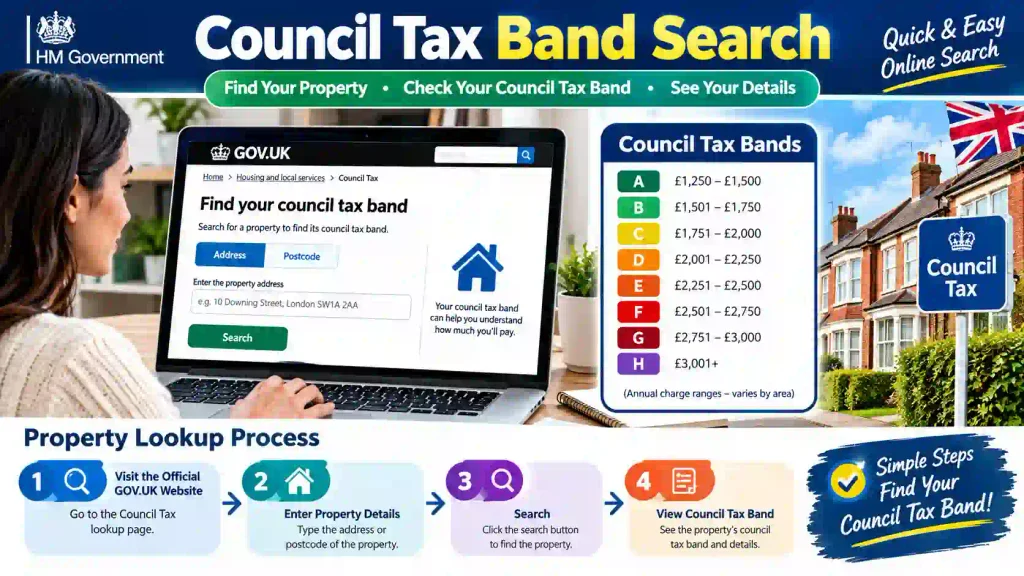
You can check your Council Tax band using the official government service for England and Wales or the Scottish Assessors system for properties in Scotland. GOV.UK provides an online service that allows users to look up a property by address or postcode.
First, identify your property’s full address or postcode. Next, use the official Council Tax band service and compare the displayed information with your bill.
If you believe the band is incorrect, you may be able to challenge it by providing evidence to support your case. GOV.UK explains that changes to a property or surrounding area can sometimes affect its valuation circumstances.
For Scotland, use the Scottish Assessors website to find the relevant property band. The Scottish Government confirms that Scottish properties use bands A through H.
How Much Is Council Tax in the UK?
There is no single Council Tax amount for the whole UK because the bill depends on the property band, local authority and household circumstances. The most useful way to estimate your bill is to check the charge published by the council responsible for your property.
In England, the average Band D Council Tax for 2026–27 is £2,392, including adult social care and parish precepts — Source: MHCLG, 2026.
The same official statistics report an average Council Tax per dwelling of £1,868 in England for 2026–27 — Source: MHCLG, 2026.
However, these averages should not be treated as your personal bill. For example, a Band A household with an eligible discount can pay substantially less than a full Band D household in another council area.
Factor
How it can affect your bill
Property band
Determines the basic band charge
Local authority
Sets the applicable local charge
Number and status of residents
Can affect discounts or disregards
Student status
Can affect liability or exemptions
Disability-related circumstances
May qualify for a reduction
Income and benefits
May affect Council Tax Reduction
Empty-property status
Special local rules may apply
Who Has to Pay Council Tax in the UK?
You will usually have to pay Council Tax if you are aged 18 or over and are responsible for a domestic property. Liability can depend on the property, who lives there and specific household circumstances.
Who Pays Council Tax in a Rented Property?
In many ordinary rental situations, the adult resident or residents are responsible for Council Tax rather than the landlord. However, specific property arrangements can create different liability rules.
For example, a tenant who rents an entire house or flat and occupies it as their home will commonly deal directly with the local council for Council Tax.
Therefore, renters should check their tenancy agreement and confirm the Council Tax position with their council. Our [UK rental costs → suggested target page] guide can also help when planning the wider cost of renting.
What Happens When Two Adults Live Together?
A standard full Council Tax bill is generally based on at least two adults living in the property. Spouses and partners who live together can be jointly responsible for the bill.
For example, two working adults sharing a property would normally need to budget for the full Council Tax charge unless another discount, exemption or reduction applies.
Who Qualifies for a Council Tax Discount or Exemption?
Council Tax discounts and exemptions reduce or remove the amount payable when a household or property meets specific eligibility conditions. The exact rules depend on the circumstances and, in some cases, the relevant local authority.
Can I Get a Single Person Council Tax Discount?
A person who lives alone may qualify for a 25% Council Tax discount. The same 25% discount can apply where the other people in the property are disregarded for Council Tax purposes.
For example, if one adult is liable for Council Tax and lives alone, the person can generally apply for the single-person discount.
Importantly, the discount is not necessarily applied automatically, so you should contact the relevant council and apply when you believe you qualify.
Do Full-Time Students Have to Pay Council Tax?
Full-time students are generally disregarded when councils calculate the number of adults for Council Tax purposes, and some student households can qualify for an exemption.GOV.UK lists full-time students among people who are not counted for Council Tax purposes.
For example, a property occupied entirely by eligible full-time students may have no Council Tax to pay under the applicable exemption rules.
However, students should still apply for the relevant exemption or discount rather than assuming it has been applied automatically. GOV.UK specifically advises people to apply for a Council Tax discount or exemption even when they are disregarded.
What Other Council Tax Reductions Exist?
Other Council Tax support can include Council Tax Reduction, disability-related reductions and discounts linked to disregarded residents. Eligibility depends on personal circumstances and local rules.
For example, Wales explains that a disabled band reduction can apply where a home has been adapted for a substantially and permanently disabled person, subject to the relevant conditions.
Low-income households may also qualify for Council Tax Reduction. Because schemes can differ, your local council should be the final source for confirming your eligibility and application requirements.
How Do I Pay My Council Tax Bill?
You normally pay Council Tax directly to the local authority responsible for your property using the payment methods and schedule offered by that council. Your bill should explain the amount due, payment dates and available payment arrangements.
First, check your Council Tax bill carefully after receiving it. Look for the property address, valuation band, annual charge, discounts or reductions and instalment dates.
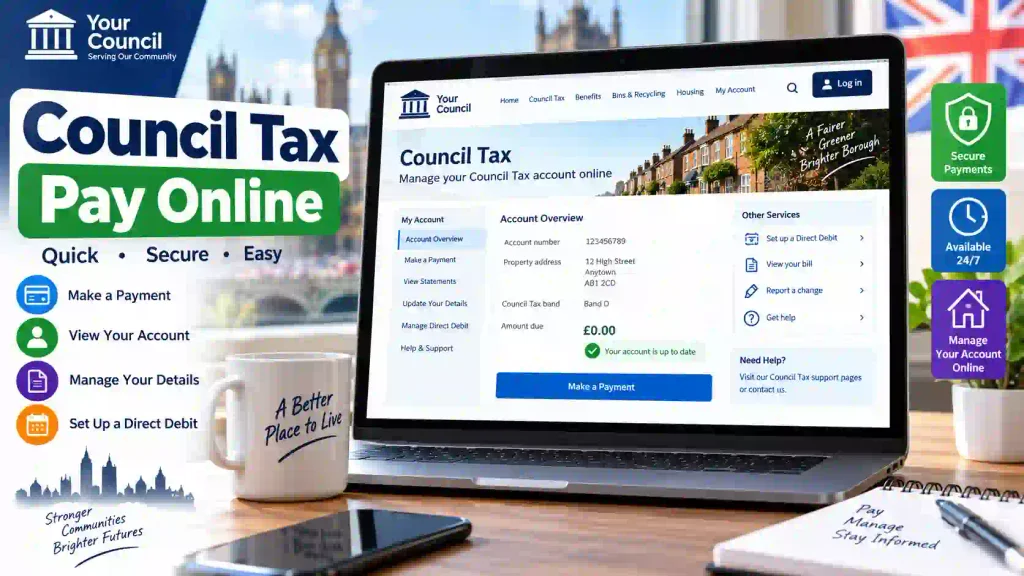
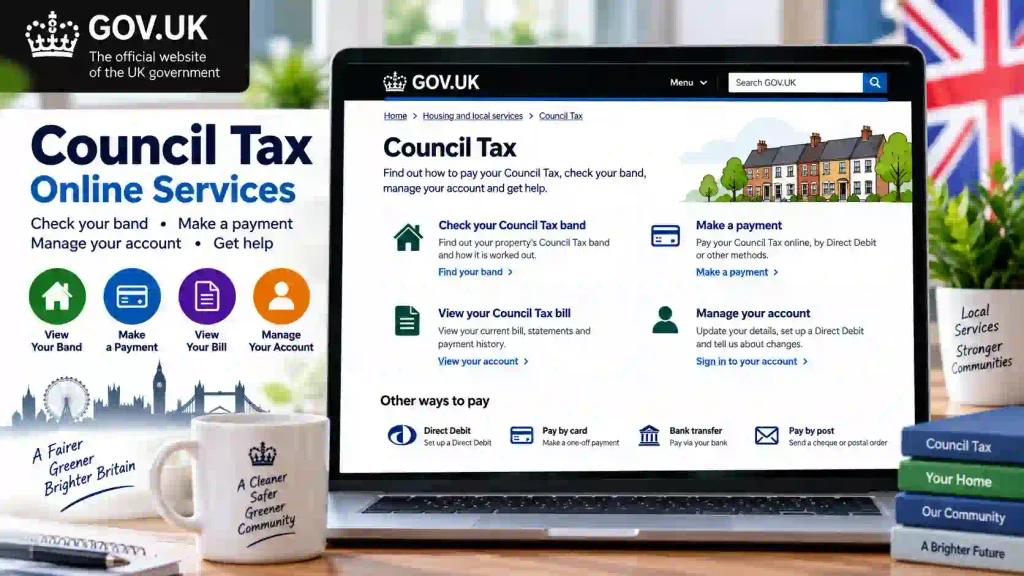
Second, use your council’s official payment service to set up or make payments. Councils may provide options such as online payments, direct debit or other approved methods.
Third, keep confirmation of payments and review future bills. Promptly checking your account can help you identify problems before they become arrears.
If you are also budgeting around employment income, resources such as [UK minimum wage 2026 → suggested target page] can help you understand how regular household bills fit into your overall finances.
What Happens If I Cannot Pay My Council Tax?
Anyone who cannot afford a Council Tax bill should contact their local council as soon as possible to discuss payment or support options available in their circumstances. Ignoring a bill can allow missed payments to develop into arrears and potentially lead to enforcement action.
First, contact the council’s Council Tax department as soon as you realise you cannot maintain the payment schedule. Explain your circumstances and ask what support or payment arrangements may be available.
Second, check whether you qualify for Council Tax Reduction or another local support scheme. GOV.UK states that people on low incomes or receiving certain benefits may be able to get Council Tax Reduction.
Third, do not assume that an unpaid bill will disappear because your financial circumstances are difficult. Contacting the council early gives you an opportunity to understand your options before the situation escalates.
What Happens to Council Tax When I Move House?
People who move home should notify their local council because moving can change their Council Tax liability and the council responsible for their bill.
For example, if you leave a property in one council area and move to another, you may need to close the old Council Tax account and register at the new address.
A practical moving-home checklist includes:
Notify your old council that you are leaving.
Provide your moving date and forwarding details when requested.
Register with the new council after moving into your new property.
Check the new property’s Council Tax band.
Check whether you qualify for a discount or exemption.
Keep copies of bills and confirmation messages.
Changes in household circumstances can also affect your bill. For example, another adult moving into your home can change the basis on which discounts or disregards are calculated.
People moving to the UK for employment can also review [UK immigration rules 2026 → suggested target page] and [UK visa sponsorship jobs → suggested target page] when planning their relocation.
What Is the Difference Between Council Tax Discounts, Exemptions and Reductions?
A Council Tax discount, exemption and reduction are different forms of support that can lower or remove Council Tax depending on the circumstances.
Support type
Basic meaning
Example
Discount
Reduces the normal bill
Single-person discount
Exemption
Removes Council Tax liability under qualifying conditions
Certain student-occupied properties
Reduction
Lowers the amount based on specific circumstances
Council Tax Reduction for eligible low-income households
Disregard
Means a person is not counted when calculating the household bill
Eligible full-time student
Moreover, being disregarded does not always mean the property itself is exempt. A disregarded resident can affect the percentage of Council Tax charged without automatically eliminating the bill.
For example, one liable adult living with a person who is disregarded may qualify for a 25% discount rather than a complete exemption.
What Tools Can I Use to Check My Council Tax?
Official government and local-authority tools are the most reliable way to check your Council Tax band, bill, discounts and payment arrangements. Because Council Tax is administered locally, the relevant council’s website should be your main practical resource.
Useful resources include:
GOV.UK Council Tax guidance for general rules, payments, reductions and liability.
GOV.UK Council Tax band checker for properties in England and Wales.
Scottish Assessors for Council Tax bands in Scotland.
Your local council website for the actual annual charge, payment methods and applications.
GOV.WALES Council Tax guidance for Wales-specific discounts, exemptions and reductions.
Suggested Council Tax Visual
This diagram can help readers understand that the final Council Tax bill is not determined by the property band alone.
What’s Next: How Do I Check and Manage My Council Tax?
The easiest way to manage Council Tax is to check your band, confirm your bill, review your eligibility and maintain the payment arrangement. A simple checklist can prevent many common problems.
Identify your local council. Confirm which authority is responsible for your property.
Check your Council Tax band. Use the appropriate official valuation service.
Review your bill. Check the address, band, annual charge, discounts and instalment dates.
Check for support. Look for single-person discounts, student arrangements, disability-related reductions, exemptions and Council Tax Reduction.
Set up payments. Choose an available payment method and keep evidence of payments.
Update your council after moving. Tell the relevant council when you move in or out.
Contact the council about financial difficulty. Do not ignore missed payments or letters about arrears.
Keep your records. Save bills, applications, correspondence and payment confirmations.
Council Tax is a local household tax whose final cost depends on the property’s band, the relevant local authority and any discounts, exemptions or reductions that apply. Understanding these factors can make it easier to budget accurately and identify support you may be entitled to.
Moreover, Council Tax rules can vary according to location and personal circumstances, so an online general guide cannot replace confirmation from your local council. Check your band, read your bill carefully, apply for relevant reductions and notify the council whenever your circumstances change.
Finally, if you cannot afford your Council Tax, contact the council promptly rather than ignoring the bill. Taking action early can help you understand available payment or support options and keep your Council Tax account under control.
Written by:Dr.Yankee — SEO content writer and UK-focused immigration, employment and public-information content specialist.
Reviewed by:Human editorial and subject-matter review recommended before publication, particularly for local Council Tax rules, current rates, exemptions and financial-support eligibility.
Disclaimer: This article was initially drafted using AI assistance. However, the content has undergone thorough revisions, editing, and fact-checking by human editors and subject matter experts to ensure accuracy. Council Tax rules, rates and eligibility can vary by UK nation, local authority and individual circumstances. Always verify your position with the relevant local council and official government guidance.