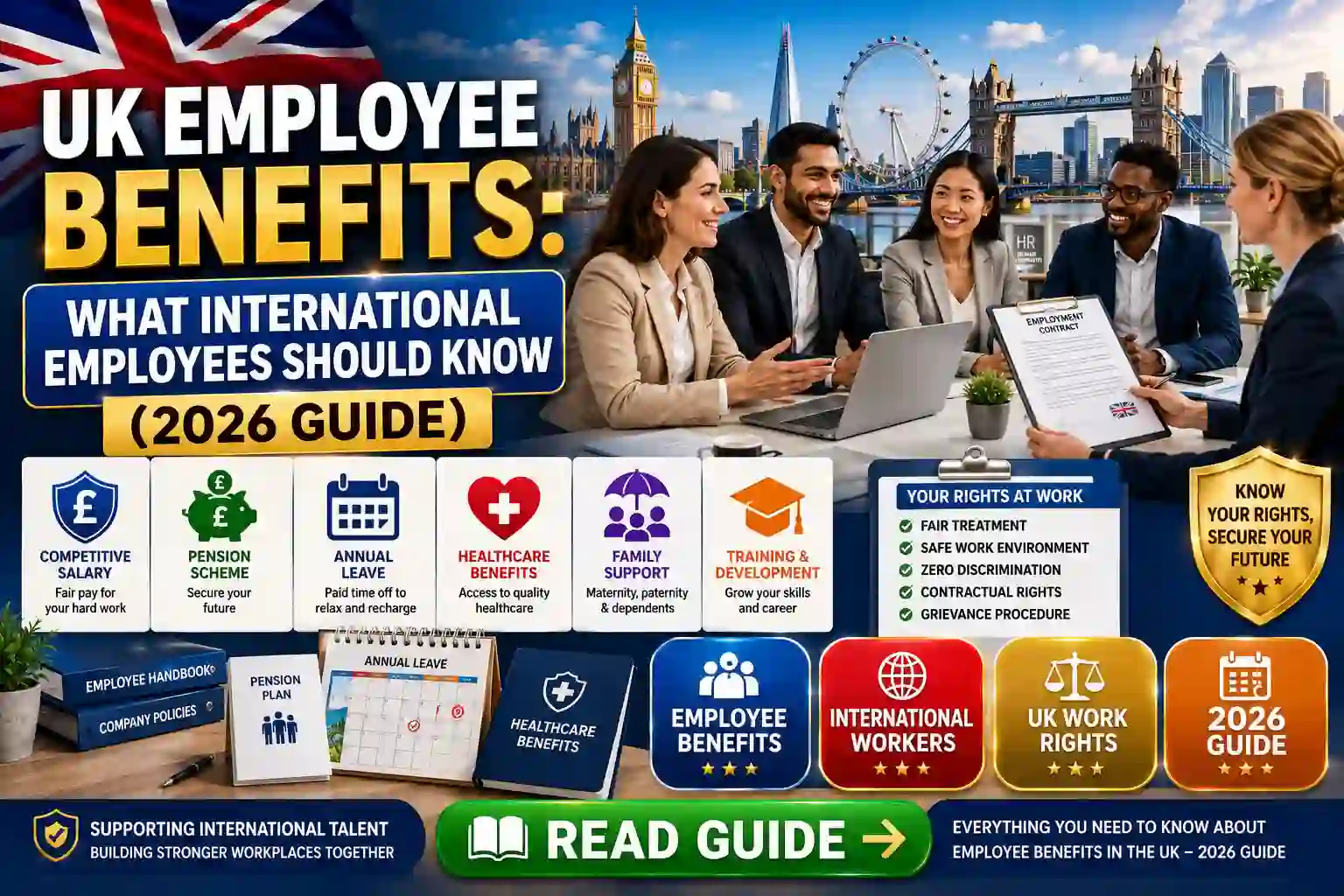
UK Employee Benefits 2026: Discover everything international workers need to know about UK employment benefits, including paid annual leave, workplace pensions, sick pay, maternity leave, flexible working, NHS benefits, Skilled Worker Visa rights and employee perks before accepting a UK job.
UK Employee Benefits 2026 – Ultimate Guide Every International Worker Must Read
👉 Join a WhatsApp channel that posts ONLY UK visa sponsorship jobs: WhatsApp Channel
UK Employee Benefits Guide 2026 for International Workers
Relocating to the United Kingdom for work is an exciting prospect, but knowing your employment perks is just as vital as obtaining a good job. You have a range of employment rights and benefits, no matter what legal work route you are on, whether this is a Skilled Worker Visa, Health and Care Worker Visa or another way.
Many overseas workers focus primarily on money, but employee benefits can be a large part of the entire worth of a position. • Financial stability and work-life balance: paid annual leave, pension contributions, maternity and paternity leave, statutory sick pay, flexible working options and professional development possibilities.
This ultimate guide covers everything international workers need to know about employee benefits in the UK in 2026.
Why Employee Benefits are Important
Benefits are perks that firms provide to employees in addition to wages. Some are required by UK employment legislation. Others are discretionary bonuses to attract and keep skilled employees.
Good employee perks can enable you to:
Enhance your financial security
Maintain a healthy balance between work and personal life
Save on healthcare and travel costs
Create retirement savings
Assist your family
Assist career growth
UK Statutory Employee Benefits
All workers working legally in the UK are entitled to certain employment rights.
1. Annual Leave Paid
Most workers are eligible for:
5.6 weeks annual paid holiday
Equivalent of 28 days for full time employees
There may be public holidays based on your contract of employment.
Part-time workers are entitled to holidays on a pro rata basis.
2. Minimum Wage National
You have a right to be paid at least the national minimum wage or national living wage that applies to you, depending on your age and the law.
Never work for less than the minimal wage required by law.
3. Statutory Sick Pay (SSP)
If you become unwell and are unable to work you may be entitled to Statutory Sick Pay subject to meeting the criteria.
Many firms now offer enhanced company sick pay above the statutory minimum.
4. Employee’s Pension
Most firms in the UK will automatically enrol eligible staff into a workplace pension.
The benefits are:
Pension contributions by employers
Employee contributions
Government tax reliefs
Retirement savings over the long term
You’ll be automatically enrolled if you fulfil the age and wage limits set down in law.
5. Leave for Parents
Eligible employees shall be entitled:
Maternity leave of up to 52 weeks
Statutory maternity pay (if you’re entitled)
Protection against pregnancy-related wrongful dismissal
6. Leave for Parents
Eligible fathers or partners may be entitled to:
Paid parental leave
Parental leave upon the birth or adoption of a child
7. Shared Parental Leave
Parents will be able to share leave following the birth or adoption – more flexibility for families.
8. Adoption Leave
Employees who adopt children may be eligible for:
Paid maternity leave
Adoption fees
Employment protection
9. Bereavement Leave of Absence
Some employees are entitled to paid leave following the death of a close family member, particularly if statutory parental bereavement leave is applicable.
10. Right to Work Flexibly
Eligible employees may seek the following flexible work arrangements:
Hybrid work
Working from home
Flexible opening & closing times
Reduced working hours
Part-time jobs
Subject to business needs approval.
Other Benefits Offered by UK Employers
Many employers offer perks that go above what the law requires.
Private Health Insurance
Some companies offer private healthcare that includes:
Specialist advice
Tests to diagnose
Private clinics
Faster treatment
Dental Insurance
Common benefits are:
Dental check ups
Fillings
Emergency care
Life Insurance
Life assurance might give financial help to your family if you die at work.
Many employers give you cover several times your pay.
Income Protection
Income protection insurance can pay you part of your salary if you can’t work because of long-term illness or accident.
Employee Assistance Program (EAP)
Confidential support services are available from many employers, such as:
Mental health counselling
Financial planning
Legal advice
Family support
Stress management
Employee Discounts
Benefits can include discounts on:
Supermarket shopping
Electronics
Mobile phone contracts
Travel
Hotels
Restaurants
Gym memberships
Gym Membership
Some employers pay or subsidise:
Gym memberships
Fitness programmes
Wellness classes
Cycle to Work Scheme
The government funded scheme allows employees to buy bikes and safety gear through salary sacrifice, making cycling to work more affordable.
Professional Education
Many employers develop their personnel by providing:
eLearning courses
Industry certifications
Professional memberships
Leadership programmes
Apprenticeships
Annual Bonus
Some organisations offer:
Performance bonuses
Company profit sharing
Christmas bonus
Retention bonuses
Benefits Often Seen in NHS Jobs
International health workers get many of extra NHS benefits.
These may often include:
Generous pension scheme
Generous vacation time
Paid training
Career advancement
Occupational health services
Maternal support
Flexible working options
Large UK Companies Benefits
Big employers usually provide:
Improved Maternity and Paternity Pay
Extra annual holiday
Health insurance
Stock plans
Employee recognition schemes
Paid volunteer days
Learning budgets
Travel expenses
Benefits of Skilled Worker Visa Holders
If you are in the UK on a Skilled Worker Visa and you are lawfully working, you have broadly the same employment rights as other eligible employees. Your access to some benefits is subject to your work contract and your eligibility under UK legislation.
Understanding Your Employment Agreement
Always read your employment contract very carefully before you accept a job.
Verify:
Pay
Working hours
Annual leave
Pension contributions
Sick leave
Notice period
Time policy
Bonus provisions
Flexible working arrangements
Training opportunities
Questions to Ask Before Taking a Job
Ask before signing your contract:
How many paid holidays do employees get?
Do you have private medical insurance?
Is the company offering improved sick pay?
What pension contributions does the employer pay?
Do you have any bonuses?
Do you pay overtime?
Funding for training courses?
Are there job development opportunities?
Is the position flexible?
What employee wellbeing programmes do you run?
International Workers Advice
Always read your work contract well.
Know Your Rights.
Keep copies of your employment papers.
Questions about a benefit? Ask HR.
If you’re able, get on your workplace pension.
Look for training possibilities.
Please speak up if you feel your rights are not being respected.
Keep up to date with changes in UK employment legislation.
What You Don’t Want to Do
Focusing only on salary and not on benefits.
Not checking holiday entitlement.
Giving up your pension without comprehending the long-term consequences.
Assume a uniform benefits package for all employers.
Not carefully reading the employment contract.
Missing deadlines for enrolment in voluntary benefit schemes.
Frequently Asked Questions (FAQs)
Do international workers get employee benefits in the UK?
Yes. Most international workers lawfully employed in the UK enjoy the same employment rights as other eligible employees, but some benefits are subject to qualifying conditions and business policies.
Are you required to provide paid holidays?
Yes. Workers entitled to it under UK employment law are entitled to paid yearly leave.
Can Skilled Worker Visa holders join a workplace pension scheme?
Employers usually enrol people automatically into a workplace pension if they match the legal eligibility criteria.
Does every employer offer private health insurance?
No. Private medical insurance is a voluntary benefit supplied by some businesses and is not legally required.
Can I negotiate benefits?
Yes. Depending on the function and employer, you could negotiate advantages such as extra yearly leave, flexible working, support with professional development or improved insurance.
Conclusions
As an employee working in the UK, employee benefits are an important element of your package and can enhance your financial stability, welfare and career opportunities. Salary is key, but benefits such as paid annual leave, workplace pensions, mandatory leave, training opportunities and employer-sponsored perks, provide significant long-term value.
Know your employment contract before you accept any job offer, ask about benefits offered and compare the entire remuneration package, not just the headline wage. Being well informed can help you make better career decisions and have a more satisfying working experience in the UK.
UK Employee Benefits 2026, UK Employee Benefits Guide, Employee Benefits UK, UK Employment Benefits, UK Work Benefits, Skilled Worker Visa Benefits UK, Health and Care Worker Benefits, UK Employment Rights, UK Annual Leave Guide, UK Workplace Pension, UK Jobs for Foreigners, Working in the UK Guide, UK Labour Rights, UK International Workers Guide, UK Employment Guide 2026