
Visa Sponsorship Jobs in UK: The Ultimate 2026 Guide to Finding Genuine Sponsored Work
Discover genuine visa sponsorship jobs in UK, verify licensed sponsors, check Skilled Worker eligibility, salary rules, CoS requirements and apply safely.
Summarize this blog post with: ChatGPT | Perplexity | Claude | Grok
You’ve probably already searched UK job boards for vacancies marked “visa sponsorship available,” but that phrase alone does not prove that a particular job qualifies for a UK work visa. In this guide, we’ll explain how visa sponsorship jobs in UK work, how to verify employers and occupations, how salary and CoS requirements fit together, and how to apply more safely in 2026.
Key Takeaways
- UK visa sponsorship jobs are vacancies where an eligible UK employer may sponsor a worker under a qualifying immigration route.
- Skilled Worker eligibility depends on factors including an approved employer, eligible occupation, Certificate of Sponsorship, salary and other immigration requirements.
- Licensed UK sponsors can be checked against the official Home Office register before applying. The register was updated on 18 September 2026.
- Job titles alone do not determine eligibility because the occupation code, actual duties and current immigration rules can affect whether a role qualifies.
- Salary requirements vary according to the immigration route, occupation and applicable circumstances, so applicants should check current GOV.UK guidance rather than rely on an old salary figure.
- A Certificate of Sponsorship is an electronic record assigned by an approved sponsor for a specific sponsored role; it is not a paper certificate.
- Care-worker recruitment from overseas has changed significantly: new overseas applications for care workers and senior care workers closed from 22 July 2025, although transitional in-country provisions continue.
What Are Visa Sponsorship Jobs in the UK?
UK visa sponsorship jobs are vacancies where a UK employer may sponsor an eligible worker under a qualifying UK immigration route. For the Skilled Worker route, the employer generally needs to be approved by the Home Office, the job must meet the relevant eligibility rules, and the worker must satisfy applicable salary and immigration requirements.
Moreover, visa sponsorship does not mean automatic visa approval. A job advertisement can mention sponsorship while the particular vacancy may still fail an immigration requirement, such as the occupation-code rules or applicable salary threshold.
For example, an employer might advertise a software developer position as “visa sponsorship available,” but the applicant should still verify the employer’s sponsor status, occupation code, salary and current Skilled Worker rules before treating the vacancy as a potential sponsored role.
How Does UK Visa Sponsorship Work for Overseas Workers?
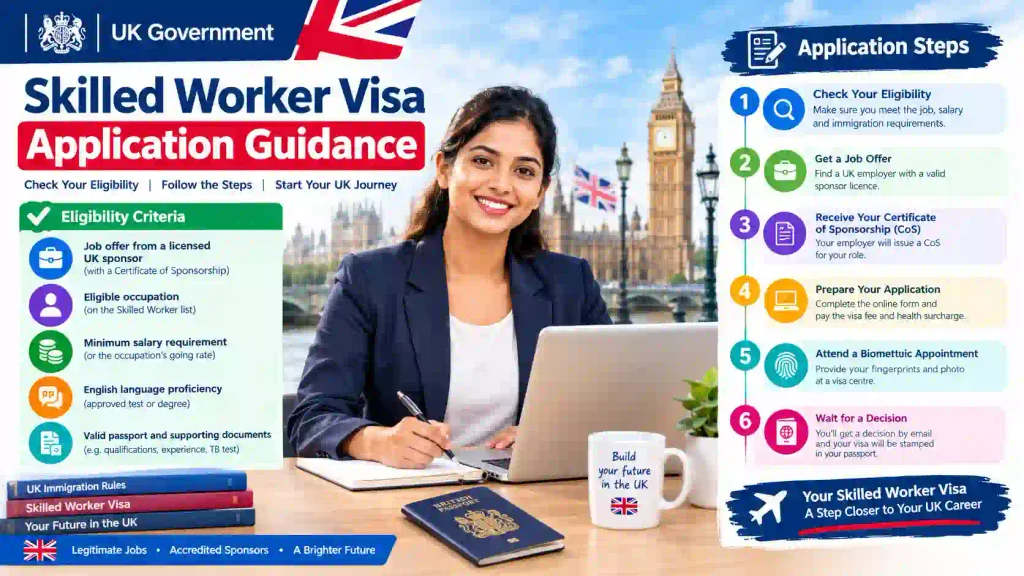
UK visa sponsorship connects an approved employer, a qualifying job and an eligible worker through the relevant immigration route. Under the Skilled Worker route, the employer must be an approved sponsor and the applicant must have an eligible job and meet the applicable requirements.
First, the employer offers the candidate a qualifying position. Next, the employer assigns a Certificate of Sponsorship (CoS) containing information about the worker and job. The worker then uses the CoS reference when applying for the relevant visa.
For example, an overseas engineer could receive an offer from an approved sponsor, have a CoS assigned for the specific role, and then use that information as part of the Skilled Worker application.
Is “Visa Sponsorship Available” Enough?
The words “visa sponsorship available” are not, by themselves, proof that a vacancy qualifies for immigration sponsorship. You should verify the employer, occupation, duties, salary and immigration route independently.
For example, an employer can hold a sponsor licence but choose not to sponsor every position it advertises. The official sponsor register identifies organisations licensed to sponsor workers, but the individual vacancy still needs to be assessed.
The job title alone is not enough because UK immigration eligibility uses occupation codes and job duties. GOV.UK advises applicants to identify the relevant four-digit occupation code when checking Skilled Worker eligibility.
Why Are Visa Sponsorship Jobs Important for International Workers?
Visa sponsorship jobs matter because workers who do not already have UK permission to work may need an eligible immigration route and an appropriate sponsoring employer to work lawfully in the UK. Sponsorship can therefore form a central part of the work-visa process.
At the same time, the UK sponsorship market has changed considerably. Official statistics show that 234,841 work-related visas were issued in the year ending June 2026, including main applicants and dependants, representing an 18% fall from the previous year. — Source: Home Office, 2026
Furthermore, Skilled Worker applications from main applicants reached 30,400 in the year ending June 2026, a 39% decrease compared with the previous year. — Source: Home Office, 2026
These figures show why applicants should use current immigration information rather than older articles or social-media posts when planning a UK job search.
UK visa sponsorship jobs for overseas applicants
Why Has the UK Sponsorship Market Changed?
UK work-visa policy changed significantly from July 2025, including higher skill and salary requirements and the closure of new overseas recruitment for care workers. The Skilled Worker skill-level requirement was raised, while the standard salary threshold increased from £38,700 to £41,700. — Source: Home Office, 2025
For example, a vacancy that might previously have appeared suitable under older Skilled Worker rules may no longer qualify under the current framework.
Therefore, older “UK sponsorship jobs” lists can become inaccurate quickly. Applicants should check GOV.UK immediately before applying.
Which UK Jobs Offer Visa Sponsorship?
UK jobs that can involve sponsorship are determined by the applicable immigration route, occupation code, employer licence, job duties and current immigration rules. Common areas include professional healthcare, technology, engineering, education and other occupations that meet the relevant requirements.
For example, a registered healthcare professional may use a Health and Care Worker route where the occupation and employer satisfy the applicable rules, while a technology professional may use the Skilled Worker route.
The following table illustrates areas that applicants commonly research; it does not mean every job in each sector automatically qualifies.
| Sector | Example roles to investigate | What to verify |
|---|---|---|
| Healthcare | Doctors, nurses, eligible health professionals | Occupation, registration, employer and salary |
| Technology | Software developers, IT professionals and specialist roles | Occupation code, duties and salary |
| Engineering | Engineers and technical professionals | Occupation code and going rate |
| Education | Eligible teachers and education leadership roles | Role, national pay scale and eligibility |
| Construction | Selected eligible skilled trades | Current list and salary rules |
| Professional services | Selected business and specialist occupations | Occupation code and salary |
| Social care | Limited transitional/in-country opportunities | Current immigration rules and location |
| Hospitality | Selected eligible specialist roles | Occupation code and current route |
UK jobs with visa sponsorship by profession
Which Jobs Are Eligible for the Skilled Worker Visa?
Skilled Worker eligibility is determined using occupation codes rather than job titles alone. GOV.UK categorises occupations as Higher Skilled, Medium Skilled or Ineligible, with additional conditions applying to some medium-skilled occupations.
For example, two jobs with similar titles can have different eligibility depending on their actual duties and the occupation code used by the employer.
Moreover, the occupation-code system changed on 4 April 2024, meaning applicants should not automatically rely on an old occupation code found in an older job article. — Source: GOV.UK, 2025
The official occupation database should therefore be treated as the starting point for eligibility verification.
UK Skilled Worker visa requirements
Which Industries Hire International Workers With Sponsorship?
Healthcare, technology, engineering and other qualifying professional occupations can provide sponsored-work opportunities when the specific job meets current immigration requirements. Sponsorship availability depends on the employer and role rather than the industry label alone.
For example, an engineering company can be a licensed sponsor but may advertise both eligible professional positions and non-sponsored support roles.
Therefore, sector-level research should always be followed by vacancy-level verification.
How Can I Find Visa Sponsorship Jobs in the UK?
You can find visa sponsorship jobs in UK by combining targeted job searches with employer, occupation-code and salary verification. The most reliable workflow is to search broadly first and verify each promising vacancy before investing significant time in the application.
First, search using phrases such as:
- “visa sponsorship jobs UK”
- “Skilled Worker visa jobs UK”
- “jobs with visa sponsorship UK”
- “UK sponsorship jobs for overseas applicants”
- “Certificate of Sponsorship jobs UK”
- “UK jobs with visa sponsorship [profession]”
- “UK employers that sponsor visas [profession]”
For example, a qualified software professional could search for “software developer Skilled Worker visa sponsorship UK” instead of using the much broader phrase “UK jobs.”
latest UK sponsorship vacancies
Step 1: Search Targeted Job Keywords
Targeted searches reduce irrelevant vacancies because they combine the profession with sponsorship terminology. Adding a city, occupation or employer can narrow results further.
For example, search for “registered nurse visa sponsorship Manchester” rather than simply searching “UK jobs.”
At the same time, do not assume that a sponsorship phrase guarantees eligibility. Use the search result only as a lead for further verification.
Step 2: Check the Employer
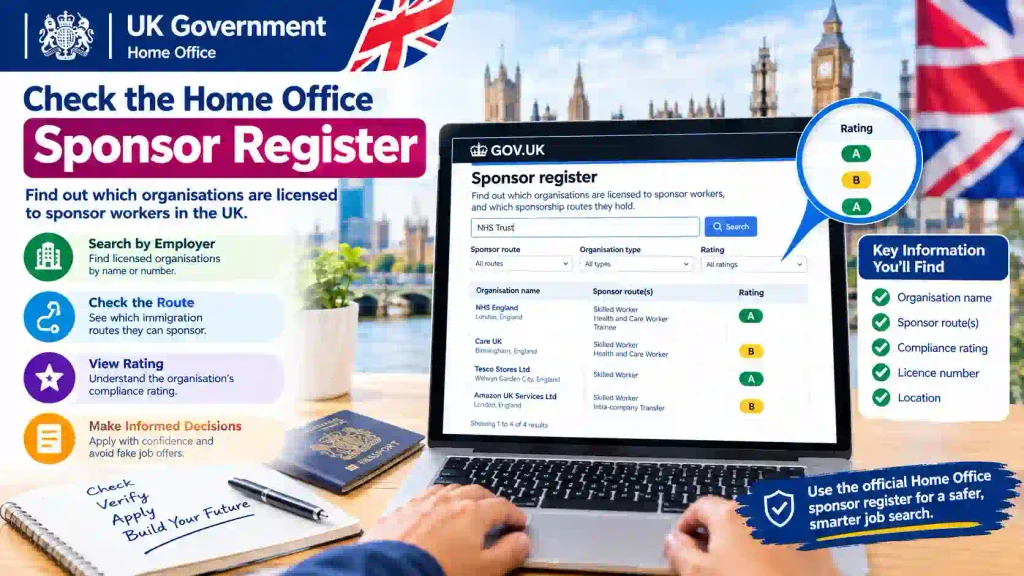
The employer should be checked against the official UK register of licensed sponsors before you rely on a sponsorship claim. The current GOV.UK register lists organisations licensed to sponsor workers and identifies their sponsorship category and rating.
For example, if a recruitment advertisement names a company, search for that organisation in the official sponsor register and confirm that the relevant worker route is covered.
Step 3: Check the Occupation Code
The occupation code connects the advertised work to the Skilled Worker eligibility framework. GOV.UK provides an occupation list and advises applicants to use the relevant code when determining whether a job qualifies.
For example, do not rely only on the title “IT Manager”; compare the actual duties and occupation classification used for the role.
Step 4: Check the Salary
A Skilled Worker salary normally has to meet the higher of the applicable general salary threshold or the occupation’s going rate, subject to permitted exceptions. The current standard Skilled Worker threshold is generally £41,700 per year, or the applicable going rate if that is higher. — Source: GOV.UK, 2026
For example, an advertised salary of £42,000 does not automatically qualify if the applicable occupation going rate is £45,000.
Step 5: Read the Vacancy Carefully
A genuine sponsorship vacancy should contain enough information for you to investigate the employer, role and employment conditions. Look for the employer’s legal name, job duties, location, salary, working hours and clear information about sponsorship.
For example, an advertisement that demands a large payment simply to “secure sponsorship” should be treated as a serious warning sign.
How Can I Check if a UK Employer Is a Licensed Sponsor?
You can check whether a UK organisation is licensed to sponsor workers using the official Home Office Register of licensed sponsors. The register was updated on 18 September 2026 and contains organisations licensed on Worker and Temporary Worker routes, together with sponsorship categories and ratings.
For example, if an employer claims to sponsor Skilled Workers, search its organisation name in the register and inspect the relevant route information.
What Does the Sponsor Register Prove?
The sponsor register proves that an organisation holds the relevant sponsorship licence; it does not prove that every vacancy at that organisation is eligible for sponsorship. The specific job must still satisfy the applicable immigration requirements.
For example, a large employer might hold a Worker sponsor licence while advertising administrative, temporary or other roles that are not suitable for the Skilled Worker route.
The register is therefore a verification tool, not a job-approval certificate.
What Should You Compare?
Applicants should compare the employer’s registered identity with the name and details shown in the vacancy. Useful checks include:
- Employer name
- Sponsorship route
- Sponsor rating
- Job title
- Job duties
- Work location
- Salary
- Contract type
- Occupation code
- Sponsorship statement
The employer’s own career page can provide additional evidence about the vacancy.
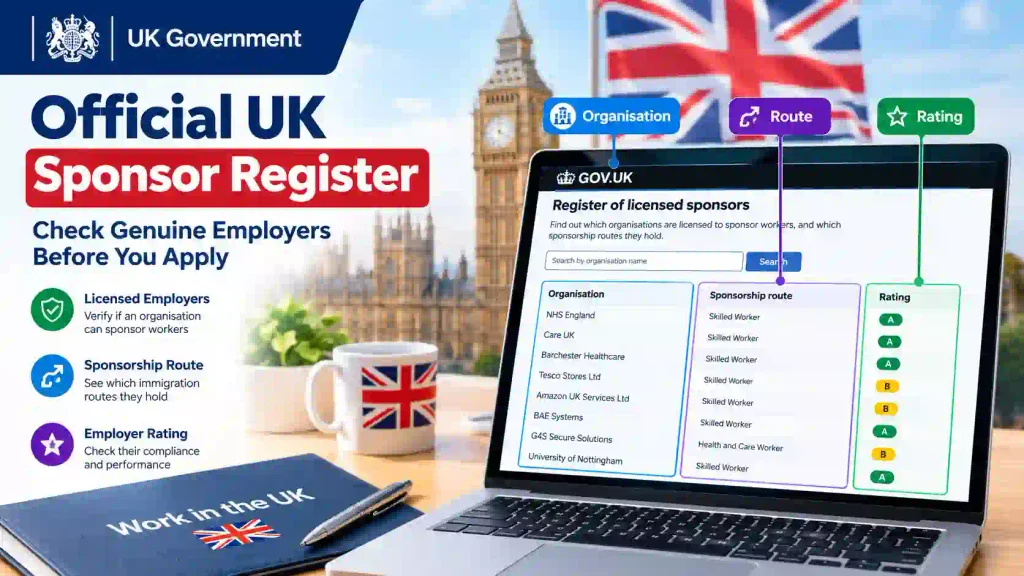
Official UK sponsor register showing organisation, route and rating fields
What Salary Do I Need for a UK Sponsored Job?
The salary required for a UK sponsored job depends on the immigration route, occupation and applicable salary rules. For the standard Skilled Worker framework, GOV.UK currently states that the usual minimum is £41,700 per year or the occupation’s applicable going rate, whichever is higher, although exceptions and different salary provisions exist.
For example, a £42,000 offer can still fail the usual salary test if the occupation’s going rate is £45,000.
What Is the Skilled Worker Going Rate?
The going rate is the occupation-specific salary benchmark used alongside the general Skilled Worker salary threshold. GOV.UK publishes annual going rates by occupation code, with figures generally based on a 37.5-hour working week and pro-rated for different working patterns.
For example, someone working fewer or more hours should not simply copy a full-time annual figure without considering the applicable working pattern.
Can Some Applicants Qualify Below the Standard Salary?
Some applicants and occupations can qualify under different salary provisions or permitted discounts. These circumstances can include particular immigration routes, eligible occupations on the Immigration Salary List and specific applicant categories.
For example, the Immigration Salary List includes occupations for which a lower salary calculation may apply under the relevant rules. GOV.UK states that listed jobs can have a minimum salary of 80% of the route’s usual minimum rate, subject to the detailed conditions.
Therefore, never use £41,700 as a universal answer for every sponsored job.
UK immigration salary list jobs
What Is a Certificate of Sponsorship in the UK?
A Certificate of Sponsorship is an electronic record assigned by an approved sponsor that contains information about the sponsored worker and the specific job. It is not a physical certificate, and the worker receives a unique reference number for the visa application.
For example, after an employer decides to sponsor an eligible worker, it assigns the relevant CoS through the sponsorship system and provides the reference information needed for the visa application.
How Long Is a CoS Valid?
A worker must normally use the assigned CoS within three months when applying for the relevant visa. GOV.UK states that a worker must not apply more than three months before the job start date shown on the certificate.
For example, receiving a CoS does not mean you can wait indefinitely before starting the visa application.
UK jobs with Certificate of Sponsorship
Is a CoS the Same as a Visa?
A Certificate of Sponsorship is not a visa and does not guarantee visa approval. It is one component of the application process.
For example, an applicant may have a valid CoS but still need to satisfy requirements such as identity, English-language, financial and other immigration conditions.
Can I Get a UK Work Visa Without a Job Offer?
A Skilled Worker visa normally requires a confirmed job offer from a Home Office-approved UK employer. GOV.UK states that applicants must have a job offer from an approved UK employer before applying for a Skilled Worker visa.
For example, simply travelling to the UK and searching for a Skilled Worker position does not replace the sponsorship requirement.
However, the UK has other immigration routes with different eligibility structures. Therefore, a person without a job offer should investigate whether another route applies to their individual circumstances rather than assuming Skilled Worker is the only possibility.
Can Care Workers Still Get UK Visa Sponsorship?
New overseas applications for UK care worker and senior care worker positions under the relevant work route closed from 22 July 2025. GOV.UK states that employers can no longer sponsor new care workers or senior care workers arriving from overseas under this route, although transitional in-country arrangements continue.
For example, a person already in the UK may have an in-country route available under transitional provisions, while a person currently overseas cannot simply rely on a care-worker advertisement offering “visa sponsorship.”
Official statistics show the scale of the change: Health and Care Worker visas issued to migrants in caring personal service occupations fell by over 99%, from 107,772 to 344, between the year ending December 2023 and the year ending June 2026. — Source: Home Office, 2026
Therefore, overseas applicants should be particularly cautious with websites advertising new care-worker sponsorship from abroad.
UK care jobs with visa sponsorship
What About Healthcare Professionals?
Healthcare professionals are not all affected in the same way as care workers because eligibility depends on the occupation and immigration rules applying to the particular role. Nurses, doctors and other regulated professionals may have different requirements from care workers.
For example, a registered healthcare professional should investigate the appropriate occupation code, professional registration, salary arrangements and Health and Care Worker eligibility.
GOV.UK states that many health roles require registration with the relevant UK professional regulator before the worker can start the job.
UK healthcare jobs with visa sponsorship
How Do I Know if a UK Visa Sponsorship Job Is Genuine?
A genuine UK visa sponsorship vacancy should withstand independent checks of the employer, job, salary and immigration requirements. Applicants should never rely solely on a social-media post, messaging-app conversation or recruitment advertisement.
For example, a genuine-looking vacancy should allow you to identify the employer and independently confirm its existence and sponsorship status.
UK Visa Sponsorship Job Scam Warning Signs
Sponsorship scams often use urgency, unrealistic promises or requests for inappropriate payments. Treat the following signs cautiously:
- Requests for large payments in exchange for a job or sponsorship.
- Guarantees that a visa will definitely be approved.
- Employer names that cannot be verified.
- Job advertisements with no identifiable employer.
- Salary or duties that do not match the occupation.
- Pressure to transfer money before receiving proper documentation.
- Requests for sensitive identity or banking information through unofficial channels.
- Claims that a sponsor licence automatically guarantees a visa.
For example, “Pay £5,000 today and your UK sponsorship is guaranteed” is not an appropriate basis for trusting a recruitment offer.
Should I Pay for Sponsorship?
Applicants should understand exactly what an employer is asking them to pay before transferring money. UK immigration fees, professional services and other legitimate expenses can exist, but these should not be confused with paying someone to fabricate or “sell” a sponsorship opportunity.
For example, an applicant can verify immigration fees through official GOV.UK information rather than relying on a recruiter who demands an unexplained payment.
What Documents Do I Need for a UK Sponsored Job?
Documents for a UK sponsored job depend on the visa route and individual circumstances, but applicants should prepare employment, identity, qualification and eligibility evidence early. Exact requirements should always be checked against the current GOV.UK application guidance.
A practical preparation list includes:
- Valid passport or travel document.
- Job offer information.
- Certificate of Sponsorship reference.
- Evidence of English-language ability where required.
- Qualification evidence where relevant.
- Professional registration evidence for regulated occupations.
- Financial evidence where required.
- Criminal-record documentation where applicable.
- Tuberculosis test evidence where applicable.
- Other documents specified by the visa application.
For example, an overseas degree taught in English may require an appropriate assessment in some circumstances, while applicants without accepted evidence may need an approved English test.
GOV.UK currently states that new Skilled Worker applicants generally need English at B2 level, while certain people extending, updating or switching an existing visa held before 8 January 2026 may have a B1 requirement.
How Do I Apply for a Skilled Worker Visa After Receiving a Job Offer?
After receiving a qualifying sponsored job offer, the applicant should verify the CoS and eligibility requirements before submitting the Skilled Worker application. The process is more reliable when completed as a series of checks rather than as a single application step.
Step 1: Verify the Employer
Confirm that the employer is an approved sponsor and that the relevant sponsorship route applies. Use the current GOV.UK sponsor register before proceeding.
Step 2: Verify the Occupation
Confirm the occupation code and compare the actual job duties with the official eligible-occupation information. A job title by itself is insufficient.
Step 3: Verify the Salary
Compare the offered salary with the current general threshold and occupation-specific going rate. Use the official going-rates table and check whether a permitted salary discount or special provision applies.
Step 4: Confirm the CoS
Confirm that the sponsor has assigned the appropriate Certificate of Sponsorship and that the information matches your job offer. The CoS is an electronic record containing information about the sponsored worker and role.
Step 5: Complete the Visa Application
Submit the appropriate work-visa application using the current GOV.UK instructions and provide the requested evidence. Do not rely on a third-party article for the final application requirements.
Which UK Visa Sponsorship Resources Should I Use?
The most useful sponsorship resources combine official UK government information with verified employer career pages and reputable job-search platforms. Official sources should take priority whenever an immigration rule conflicts with a recruitment advertisement.
GOV.UK Skilled Worker Guidance
The GOV.UK Skilled Worker guidance is the primary source for current route requirements. Use it to check job eligibility, employer approval, salary rules and other requirements.
UK Skilled Worker visa requirements
Official Sponsor Register
The official sponsor register identifies organisations licensed to sponsor workers and shows sponsorship information and ratings. It was updated on 18 September 2026.
Eligible Occupation List
The official eligible-occupation database shows whether occupations are classified as Higher Skilled, Medium Skilled or Ineligible. It also provides occupation codes and related job titles.
Going Rates Table
The going-rates table provides occupation-specific salary benchmarks used in Skilled Worker eligibility checks. Salaries are generally based on a 37.5-hour working week and may need pro-rating for different working patterns.
Immigration Salary List
The Immigration Salary List identifies specific occupations and locations where different salary provisions can apply. Its detailed conditions should be checked before relying on a reduced salary figure.
Employer Career Pages
An employer’s official career page can help confirm that a vacancy actually exists. For example, if a recruitment website lists a sponsored engineering vacancy, compare the role with the employer’s own careers website.
Sponsorship Job Listings
Job websites can help you discover vacancies, but they should be treated as discovery tools rather than final immigration authorities.
latest UK sponsorship vacancies
What Should I Do After Finding a UK Visa Sponsorship Job?
After finding a potential UK sponsorship job, verify the vacancy before spending substantial time or money on the application. A simple verification workflow can eliminate many unsuitable advertisements.
UK Visa Sponsorship Job Verification Checklist
A sponsorship-job checklist helps you verify the most important requirements in a consistent order.
- Employer: Is the organisation identifiable and legitimate?
- Sponsor: Is the employer listed on the official sponsor register?
- Route: Does the sponsor hold the relevant sponsorship route?
- Occupation: What four-digit occupation code applies?
- Duties: Do the actual duties match that occupation?
- Eligibility: Is the occupation currently eligible?
- Salary: Does the offer meet the applicable salary rules?
- Location: Do location-specific rules apply?
- Sponsorship: Does the employer explicitly confirm sponsorship for this vacancy?
- CoS: Will the employer assign the appropriate CoS if you are selected?
- Documents: Can you provide the required evidence?
- Visa: Have you checked the current GOV.UK application requirements?
For example, a vacancy that passes all these checks is substantially easier to assess than one that only contains the phrase “visa sponsorship available.”
What Is the Best Way to Search for UK Sponsorship Jobs in 2026?
The most practical 2026 strategy is to combine profession-specific searches with official immigration verification. The market is changing quickly, so applicants should prioritise current information over large lists of old vacancies.
First, create a shortlist of occupations that match your qualifications and experience. Second, identify employers that appear to recruit internationally. Third, check those employers against the current sponsor register.
For example, a qualified engineer could create a list of UK engineering employers, search their career pages for relevant positions, then verify sponsorship status and occupation eligibility.
Moreover, applicants should monitor changes to salary thresholds, occupation classifications and immigration routes because UK work-visa rules can change independently of job-board content.
UK visa sponsorship job application guide
Conclusion
Visa sponsorship jobs in UK require more than finding a vacancy with the words “sponsorship available.” A reliable search process checks the employer, sponsorship licence, occupation code, actual duties, salary, CoS requirements and current immigration rules.
Moreover, the 2026 UK sponsorship environment is different from previous years. The standard Skilled Worker salary threshold is generally £41,700, occupation-specific going rates remain important, and overseas recruitment for care workers and senior care workers has closed under the relevant route.
Therefore, verify every vacancy before applying or paying money. Use GOV.UK as the final authority for immigration requirements, use the official sponsor register to check employers, and use reputable job listings and employer career pages to discover genuine opportunities.
Finally, if you are searching for UK visa sponsorship jobs, Skilled Worker jobs, healthcare sponsorship roles, engineering positions, technology jobs or other sponsored vacancies, build your search around verification rather than promises. That approach can help you focus your applications on opportunities that are more clearly aligned with the current UK immigration framework.
Written by Dr. Yankee — SEO Blog Writer and AI-Optimization Specialist, specialising in search-focused employment and UK visa sponsorship content.
Reviewed by Human editorial review team — UK employment and immigration-content fact-checking.
Disclaimer: This article was initially drafted using AI assistance. However, the content has undergone thorough revisions, editing, and fact-checking by human editors and subject matter experts to ensure accuracy. UK immigration rules, salary thresholds, occupation eligibility and sponsorship policies can change; always check the latest GOV.UK guidance before making immigration or employment decisions.